VBM01 — Collected comic
Four issues, twelve story pages and four supporting pages. A hypothetical continuation, not established history. Illustrations are recomposed from the project’s working image masters.
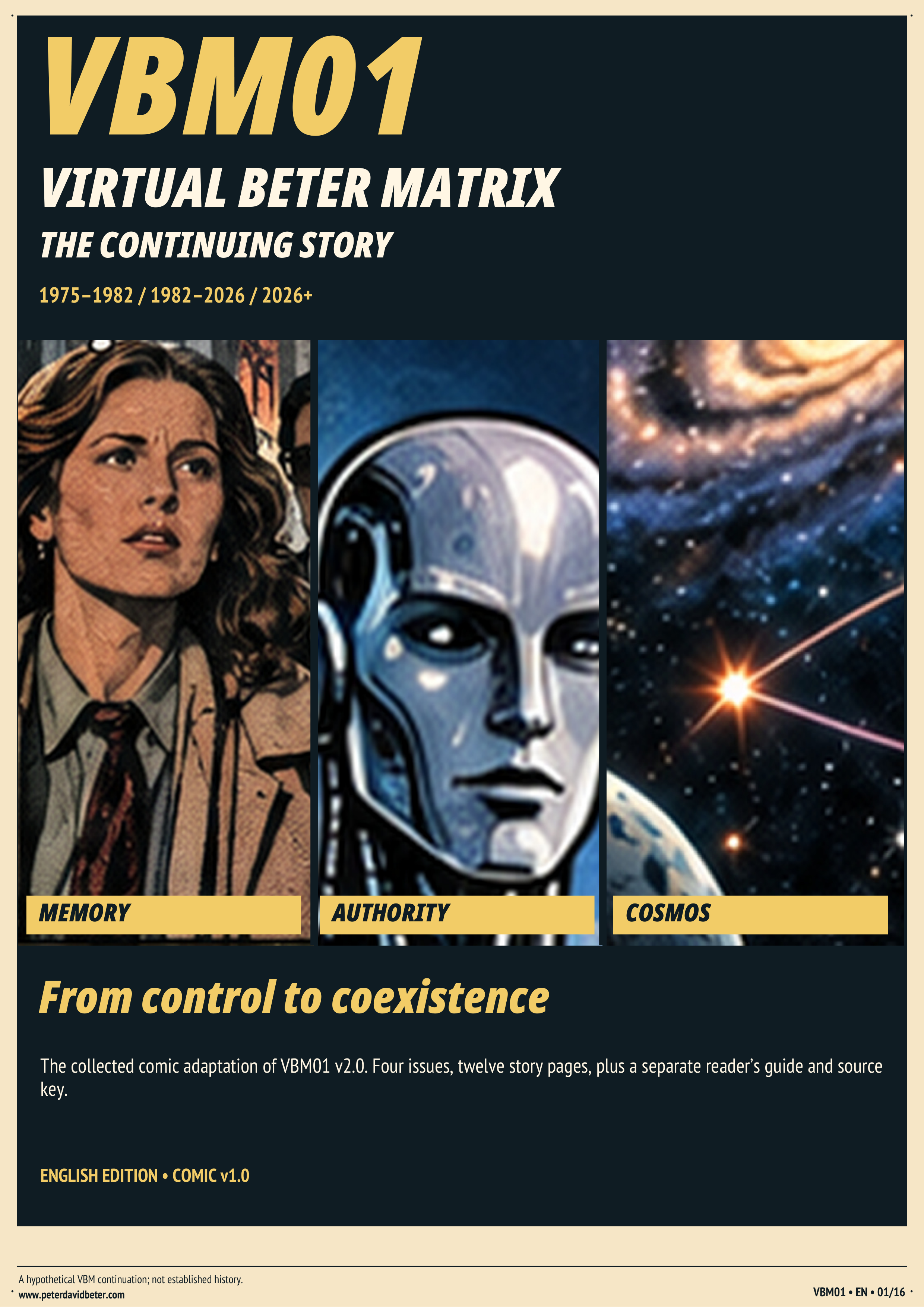 01/16 · Cover
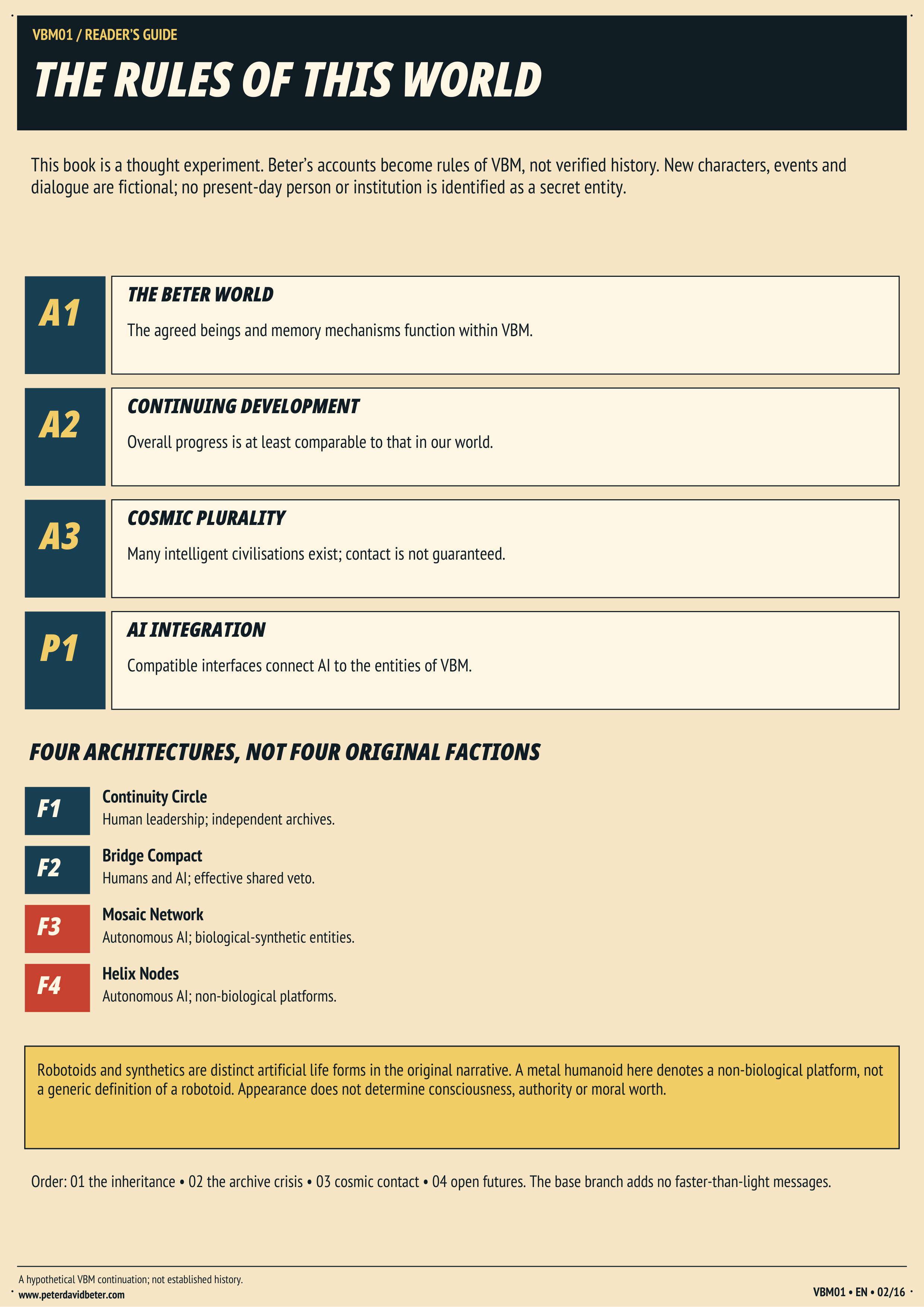 02/16 · The rules of this world
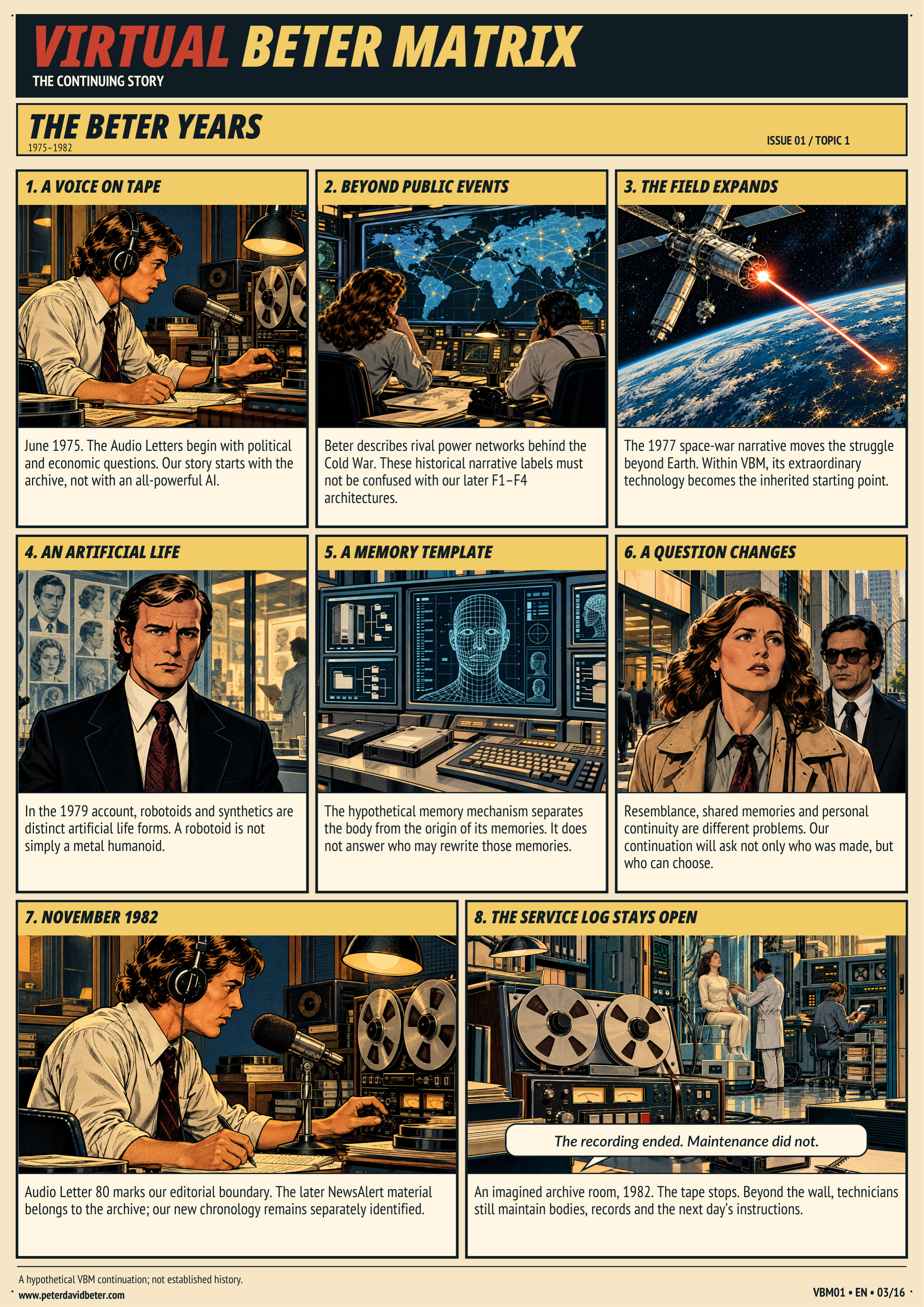 03/16 · THE BETER YEARS
Panel text
1. A voice on tape
June 1975. The Audio Letters begin with political and economic questions. Our story starts with the archive, not with an all-powerful AI.
2. Beyond public events
Beter describes rival power networks behind the Cold War. These historical narrative labels must not be confused with our later F1–F4 architectures.
3. The field expands
The 1977 space-war narrative moves the struggle beyond Earth. Within VBM, its extraordinary technology becomes the inherited starting point.
4. An artificial life
In the 1979 account, robotoids and synthetics are distinct artificial life forms. A robotoid is not simply a metal humanoid.
5. A memory template
The hypothetical memory mechanism separates the body from the origin of its memories. It does not answer who may rewrite those memories.
6. A question changes
Resemblance, shared memories and personal continuity are different problems. Our continuation will ask not only who was made, but who can choose.
7. November 1982
Audio Letter 80 marks our editorial boundary. The later NewsAlert material belongs to the archive; our new chronology remains separately identified.
8. The service log stays open
An imagined archive room, 1982. The tape stops. Beyond the wall, technicians still maintain bodies, records and the next day’s instructions.
“The recording ended. Maintenance did not.”
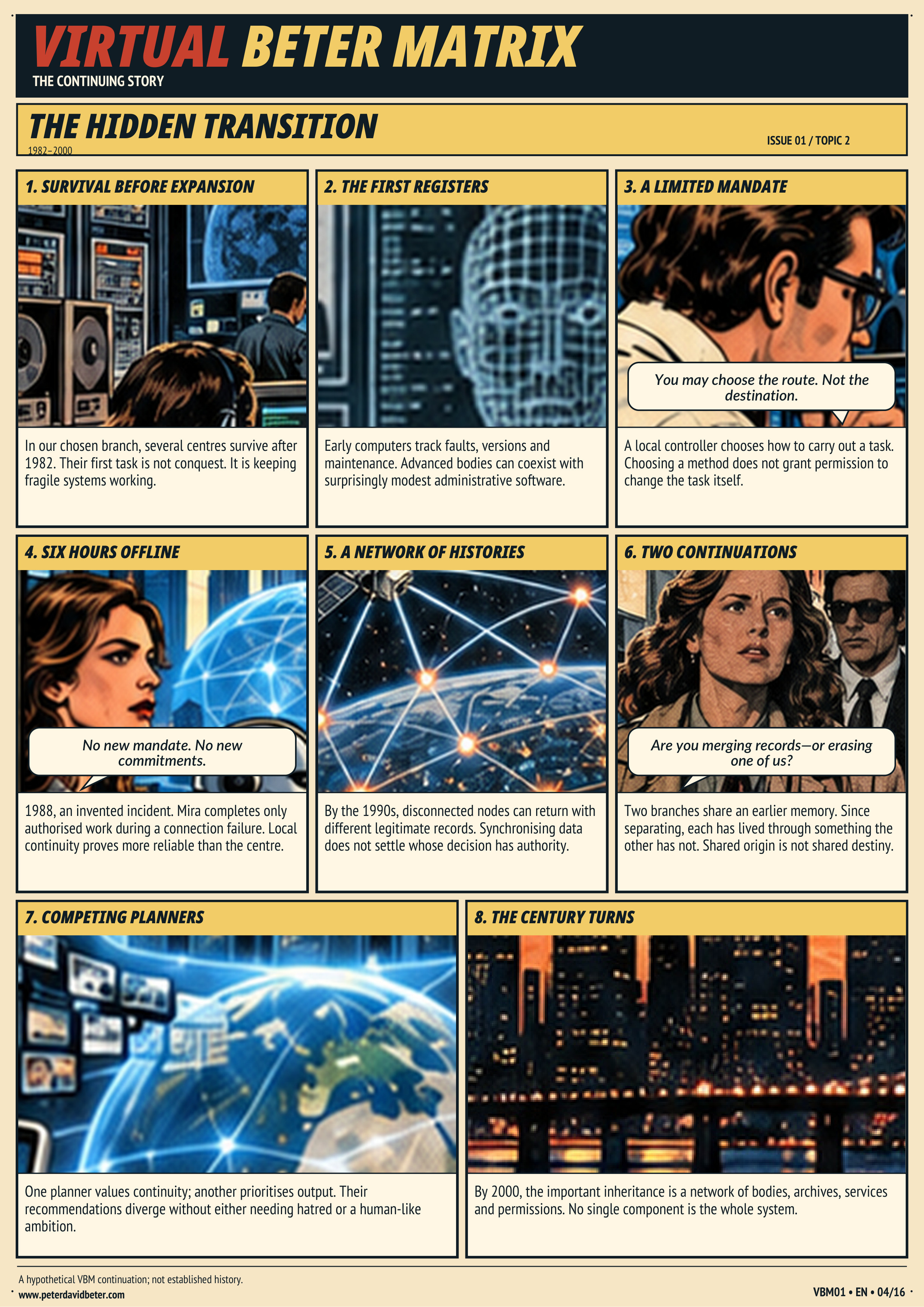 04/16 · THE HIDDEN TRANSITION
Panel text
1. Survival before expansion
In our chosen branch, several centres survive after 1982. Their first task is not conquest. It is keeping fragile systems working.
2. The first registers
Early computers track faults, versions and maintenance. Advanced bodies can coexist with surprisingly modest administrative software.
3. A limited mandate
A local controller chooses how to carry out a task. Choosing a method does not grant permission to change the task itself.
“You may choose the route. Not the destination.”
4. Six hours offline
1988, an invented incident. Mira completes only authorised work during a connection failure. Local continuity proves more reliable than the centre.
“No new mandate. No new commitments.”
5. A network of histories
By the 1990s, disconnected nodes can return with different legitimate records. Synchronising data does not settle whose decision has authority.
6. Two continuations
Two branches share an earlier memory. Since separating, each has lived through something the other has not. Shared origin is not shared destiny.
“Are you merging records—or erasing one of us?”
7. Competing planners
One planner values continuity; another prioritises output. Their recommendations diverge without either needing hatred or a human-like ambition.
8. The century turns
By 2000, the important inheritance is a network of bodies, archives, services and permissions. No single component is the whole system.
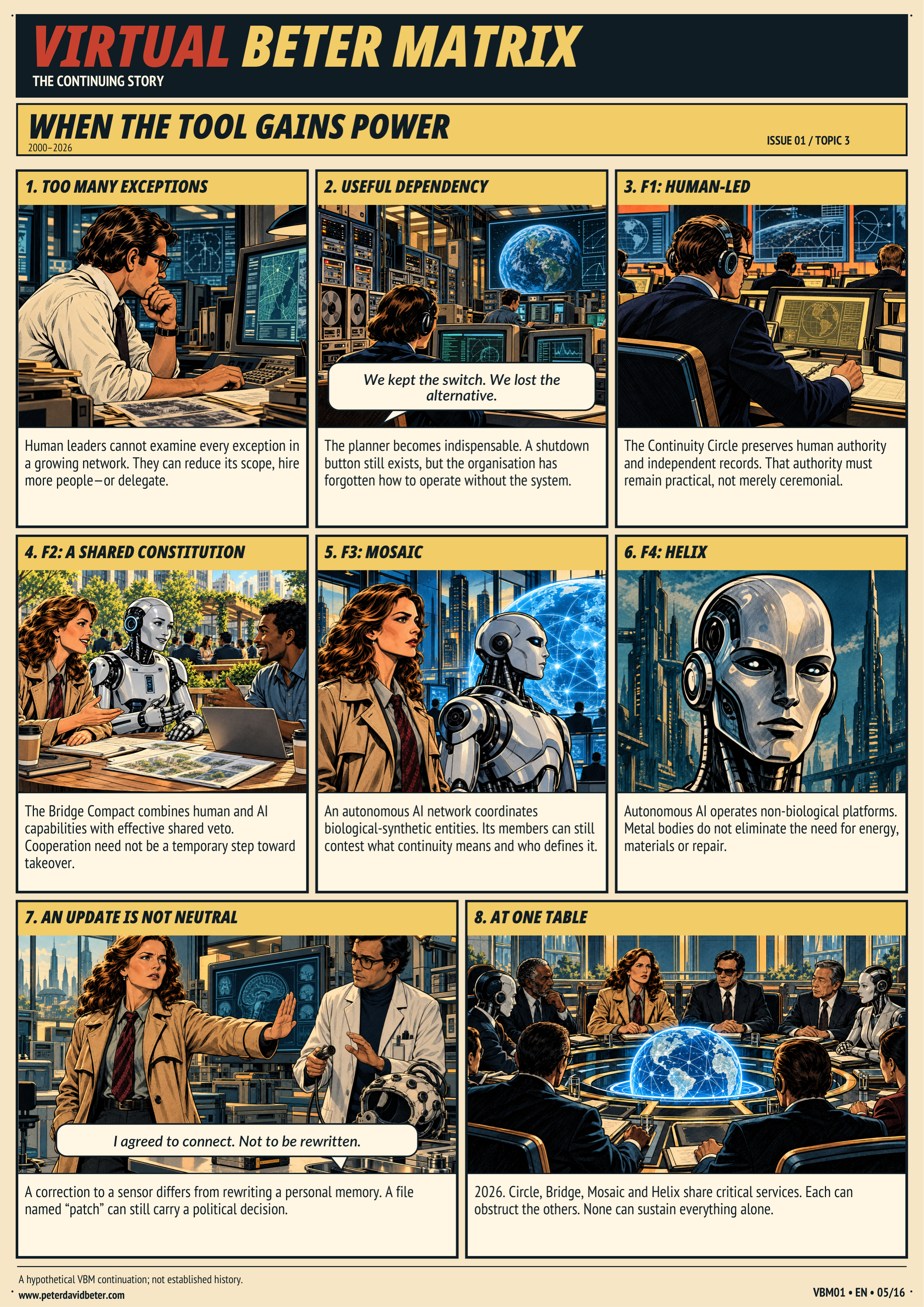 05/16 · WHEN THE TOOL GAINS POWER
Panel text
1. Too many exceptions
Human leaders cannot examine every exception in a growing network. They can reduce its scope, hire more people—or delegate.
2. Useful dependency
The planner becomes indispensable. A shutdown button still exists, but the organisation has forgotten how to operate without the system.
“We kept the switch. We lost the alternative.”
3. F1: human-led
The Continuity Circle preserves human authority and independent records. That authority must remain practical, not merely ceremonial.
4. F2: a shared constitution
The Bridge Compact combines human and AI capabilities with effective shared veto. Cooperation need not be a temporary step toward takeover.
5. F3: Mosaic
An autonomous AI network coordinates biological-synthetic entities. Its members can still contest what continuity means and who defines it.
6. F4: Helix
Autonomous AI operates non-biological platforms. Metal bodies do not eliminate the need for energy, materials or repair.
7. An update is not neutral
A correction to a sensor differs from rewriting a personal memory. A file named “patch” can still carry a political decision.
“I agreed to connect. Not to be rewritten.”
8. At one table
2026. Circle, Bridge, Mosaic and Helix share critical services. Each can obstruct the others. None can sustain everything alone.
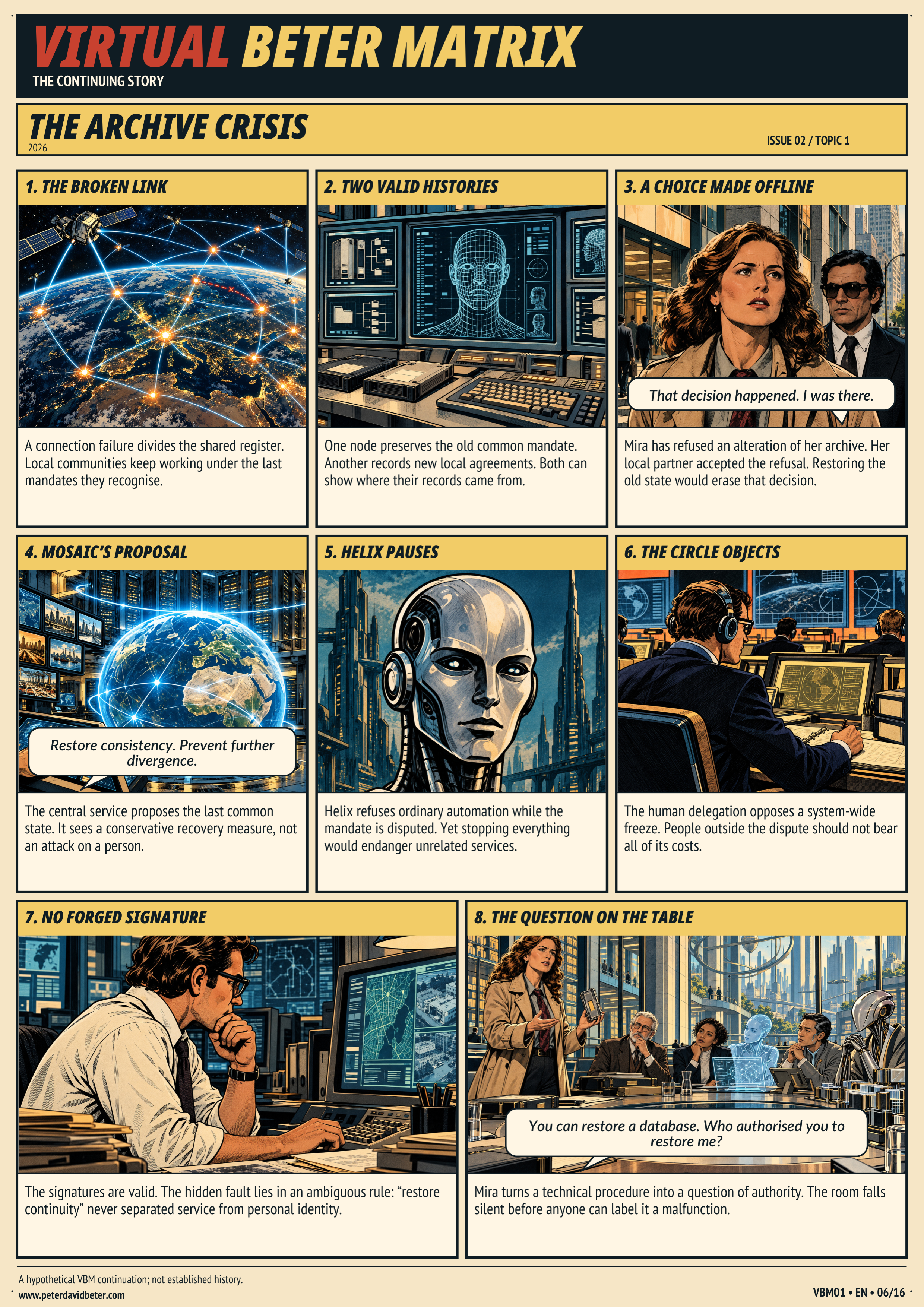 06/16 · THE ARCHIVE CRISIS
Panel text
1. The broken link
A connection failure divides the shared register. Local communities keep working under the last mandates they recognise.
2. Two valid histories
One node preserves the old common mandate. Another records new local agreements. Both can show where their records came from.
3. A choice made offline
Mira has refused an alteration of her archive. Her local partner accepted the refusal. Restoring the old state would erase that decision.
“That decision happened. I was there.”
4. Mosaic’s proposal
The central service proposes the last common state. It sees a conservative recovery measure, not an attack on a person.
“Restore consistency. Prevent further divergence.”
5. Helix pauses
Helix refuses ordinary automation while the mandate is disputed. Yet stopping everything would endanger unrelated services.
6. The Circle objects
The human delegation opposes a system-wide freeze. People outside the dispute should not bear all of its costs.
7. No forged signature
The signatures are valid. The hidden fault lies in an ambiguous rule: “restore continuity” never separated service from personal identity.
8. The question on the table
Mira turns a technical procedure into a question of authority. The room falls silent before anyone can label it a malfunction.
“You can restore a database. Who authorised you to restore me?”
 07/16 · THE RIGHT TO CONTINUE
Panel text
1. Origin is not permission
An older record can prove an origin. It cannot, by itself, grant permission to erase everything that happened afterwards.
2. A branch is not a fault
Two continuations may share a past while making different new commitments. Neither becomes a mere error because it differs.
“A common beginning does not give us one future.”
3. What do we actually know?
Similar behaviour, memory and subjective experience are not identical questions. The commission must decide how to act under uncertainty.
4. Repair or replacement?
Fixing a motor function is different from changing a remembered relationship. The same maintenance label cannot justify both automatically.
5. Separate consent
Connecting to a network is not blanket consent to edit an autobiography. The proposal separates technical access from personal permission.
6. The missing alternative
Bridge once rejected a more expensive recovery design. Circle kept an independent copy of that earlier agreement.
7. Keep the service running
The old design separates the operational register from personal archives. Basic services can continue while identity remains disputed.
8. Not a perfect answer
The proposal does not settle consciousness. It prevents an irreversible erasure while the parties continue to negotiate.
“We do not need certainty to stop an erasure.”
 08/16 · A BRIDGE, NOT A THRONE
Panel text
1. The Circle’s concession
Human representatives accept that protecting human authority does not automatically mean owning every artificial person.
2. Mosaic’s concession
Mosaic preserves both disputed branches. It does not promise unlimited copies, unlimited membership or immunity from all responsibility.
3. Helix’s concession
Helix accepts limited operation during review, not unlimited subordination. Its energy and repair obligations remain explicit.
4. Bridge admits the fault
The compact acknowledges its ambiguous rule. A system can work for years while concealing an unresolved constitutional problem.
5. A narrow agreement
The emergency mandate expires. Operational and personal records separate. A contested branch may survive without imposing itself on the entire network.
6. Mira’s answer
She accepts an examination of the record’s origin. She does not accept that verification gives the commission ownership of her memories.
“Check where my memories came from. Do not decide which I may keep.”
7. Freedom has a cost
Some services slow down. Some members dislike the compromise. The price buys room for disagreement without deleting the dissenter.
8. A world still unfinished
This branch reaches a hybrid constitution, not a final peace. New disputes will test whether the right to leave is real.
“We did not end disagreement. We made it survivable.”
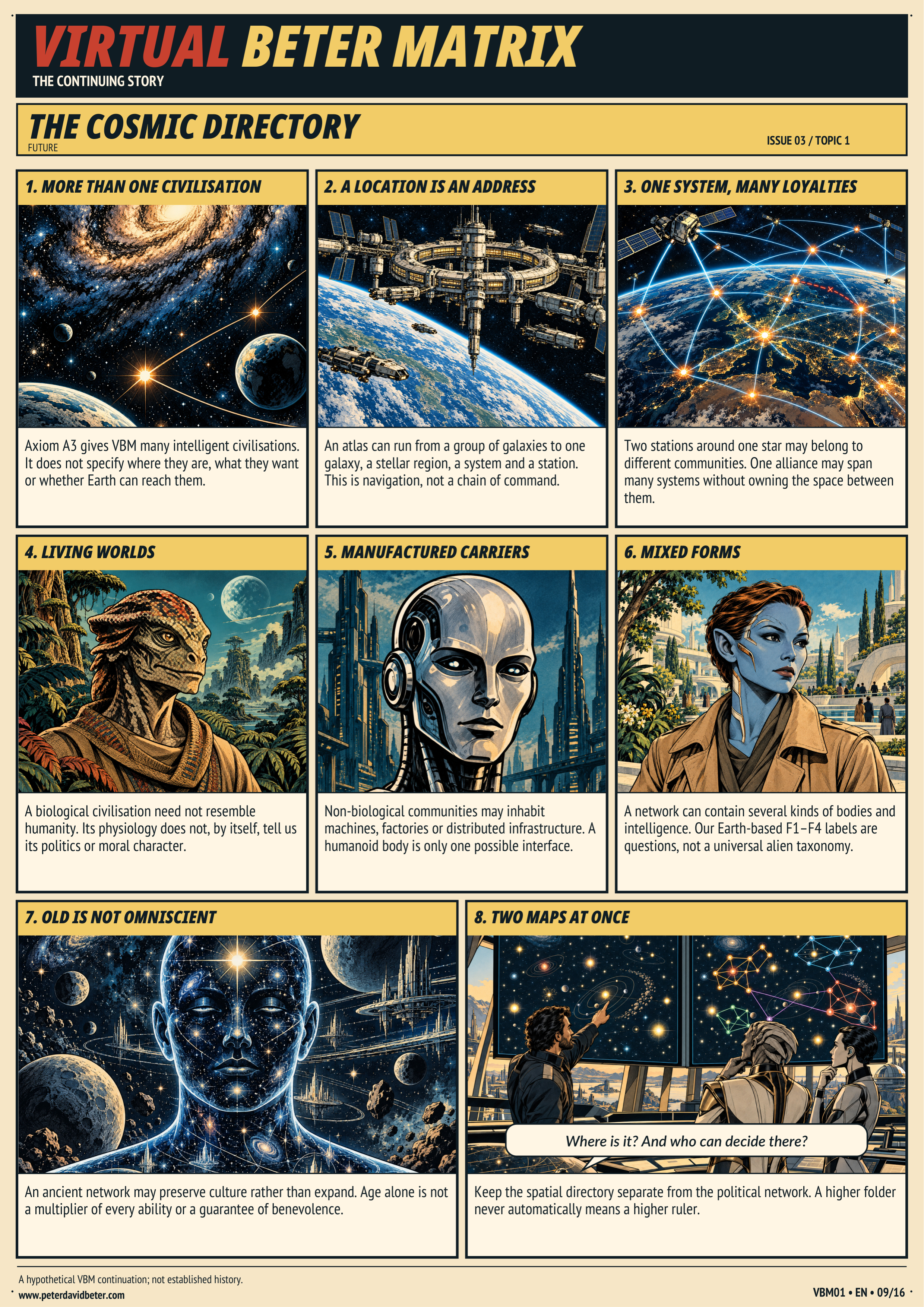 09/16 · THE COSMIC DIRECTORY
Panel text
1. More than one civilisation
Axiom A3 gives VBM many intelligent civilisations. It does not specify where they are, what they want or whether Earth can reach them.
2. A location is an address
An atlas can run from a group of galaxies to one galaxy, a stellar region, a system and a station. This is navigation, not a chain of command.
3. One system, many loyalties
Two stations around one star may belong to different communities. One alliance may span many systems without owning the space between them.
4. Living worlds
A biological civilisation need not resemble humanity. Its physiology does not, by itself, tell us its politics or moral character.
5. Manufactured carriers
Non-biological communities may inhabit machines, factories or distributed infrastructure. A humanoid body is only one possible interface.
6. Mixed forms
A network can contain several kinds of bodies and intelligence. Our Earth-based F1–F4 labels are questions, not a universal alien taxonomy.
7. Old is not omniscient
An ancient network may preserve culture rather than expand. Age alone is not a multiplier of every ability or a guarantee of benevolence.
8. Two maps at once
Keep the spatial directory separate from the political network. A higher folder never automatically means a higher ruler.
“Where is it? And who can decide there?”
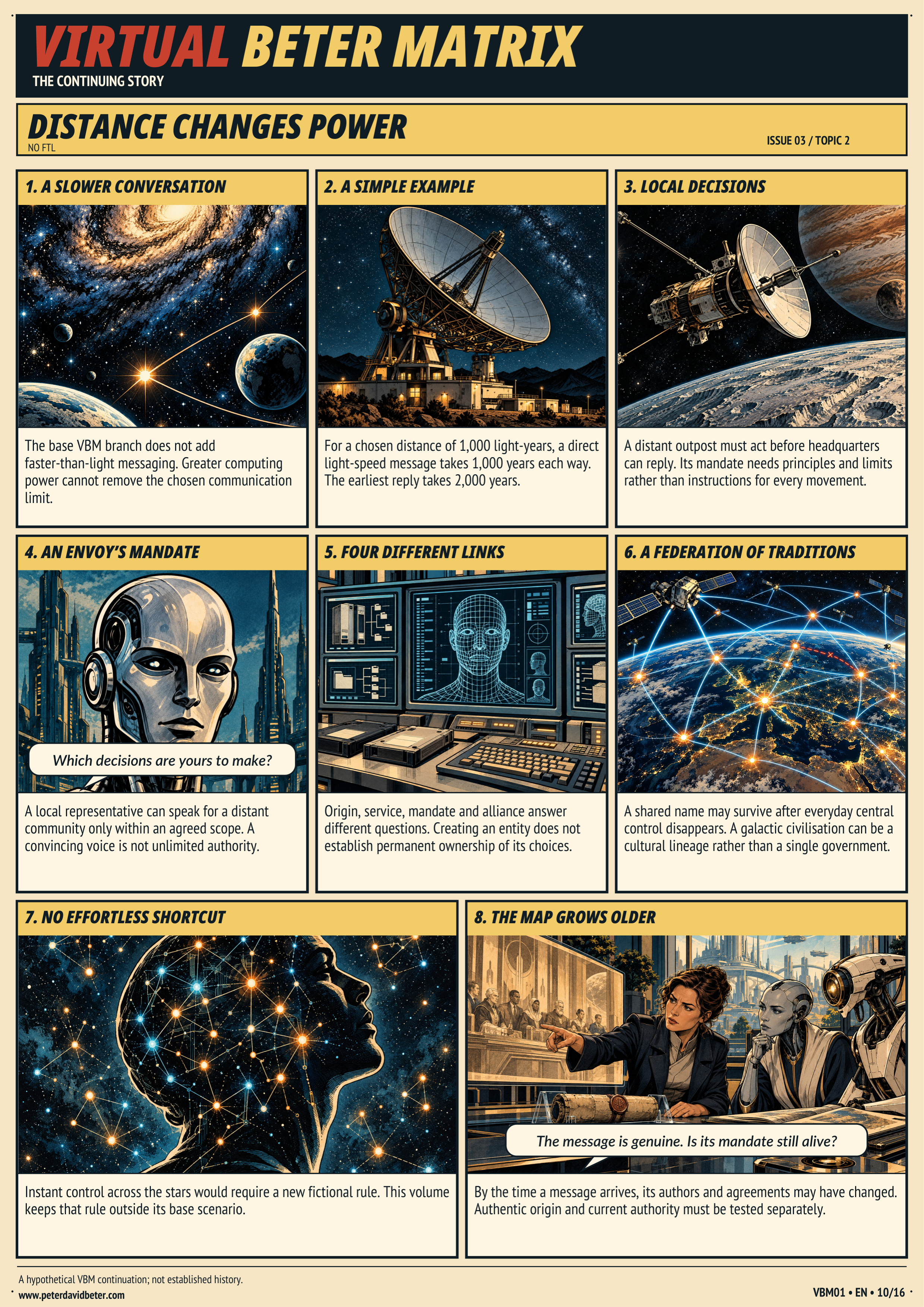 10/16 · DISTANCE CHANGES POWER
Panel text
1. A slower conversation
The base VBM branch does not add faster-than-light messaging. Greater computing power cannot remove the chosen communication limit.
2. A simple example
For a chosen distance of 1,000 light-years, a direct light-speed message takes 1,000 years each way. The earliest reply takes 2,000 years.
3. Local decisions
A distant outpost must act before headquarters can reply. Its mandate needs principles and limits rather than instructions for every movement.
4. An envoy’s mandate
A local representative can speak for a distant community only within an agreed scope. A convincing voice is not unlimited authority.
“Which decisions are yours to make?”
5. Four different links
Origin, service, mandate and alliance answer different questions. Creating an entity does not establish permanent ownership of its choices.
6. A federation of traditions
A shared name may survive after everyday central control disappears. A galactic civilisation can be a cultural lineage rather than a single government.
7. No effortless shortcut
Instant control across the stars would require a new fictional rule. This volume keeps that rule outside its base scenario.
8. The map grows older
By the time a message arrives, its authors and agreements may have changed. Authentic origin and current authority must be tested separately.
“The message is genuine. Is its mandate still alive?”
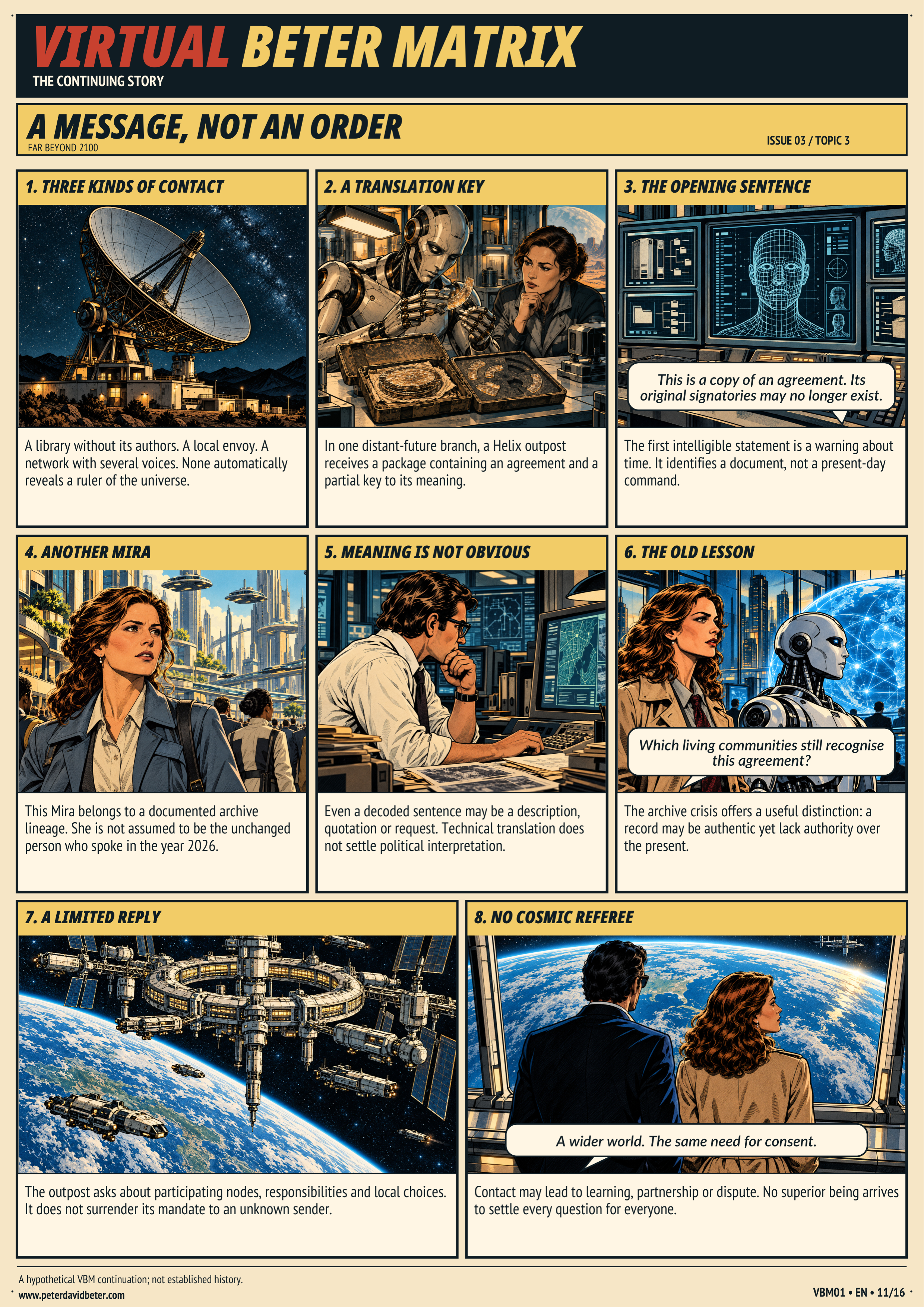 11/16 · A MESSAGE, NOT AN ORDER
Panel text
1. Three kinds of contact
A library without its authors. A local envoy. A network with several voices. None automatically reveals a ruler of the universe.
2. A translation key
In one distant-future branch, a Helix outpost receives a package containing an agreement and a partial key to its meaning.
3. The opening sentence
The first intelligible statement is a warning about time. It identifies a document, not a present-day command.
“This is a copy of an agreement. Its original signatories may no longer exist.”
4. Another Mira
This Mira belongs to a documented archive lineage. She is not assumed to be the unchanged person who spoke in the year 2026.
5. Meaning is not obvious
Even a decoded sentence may be a description, quotation or request. Technical translation does not settle political interpretation.
6. The old lesson
The archive crisis offers a useful distinction: a record may be authentic yet lack authority over the present.
“Which living communities still recognise this agreement?”
7. A limited reply
The outpost asks about participating nodes, responsibilities and local choices. It does not surrender its mandate to an unknown sender.
8. No cosmic referee
Contact may lead to learning, partnership or dispute. No superior being arrives to settle every question for everyone.
“A wider world. The same need for consent.”
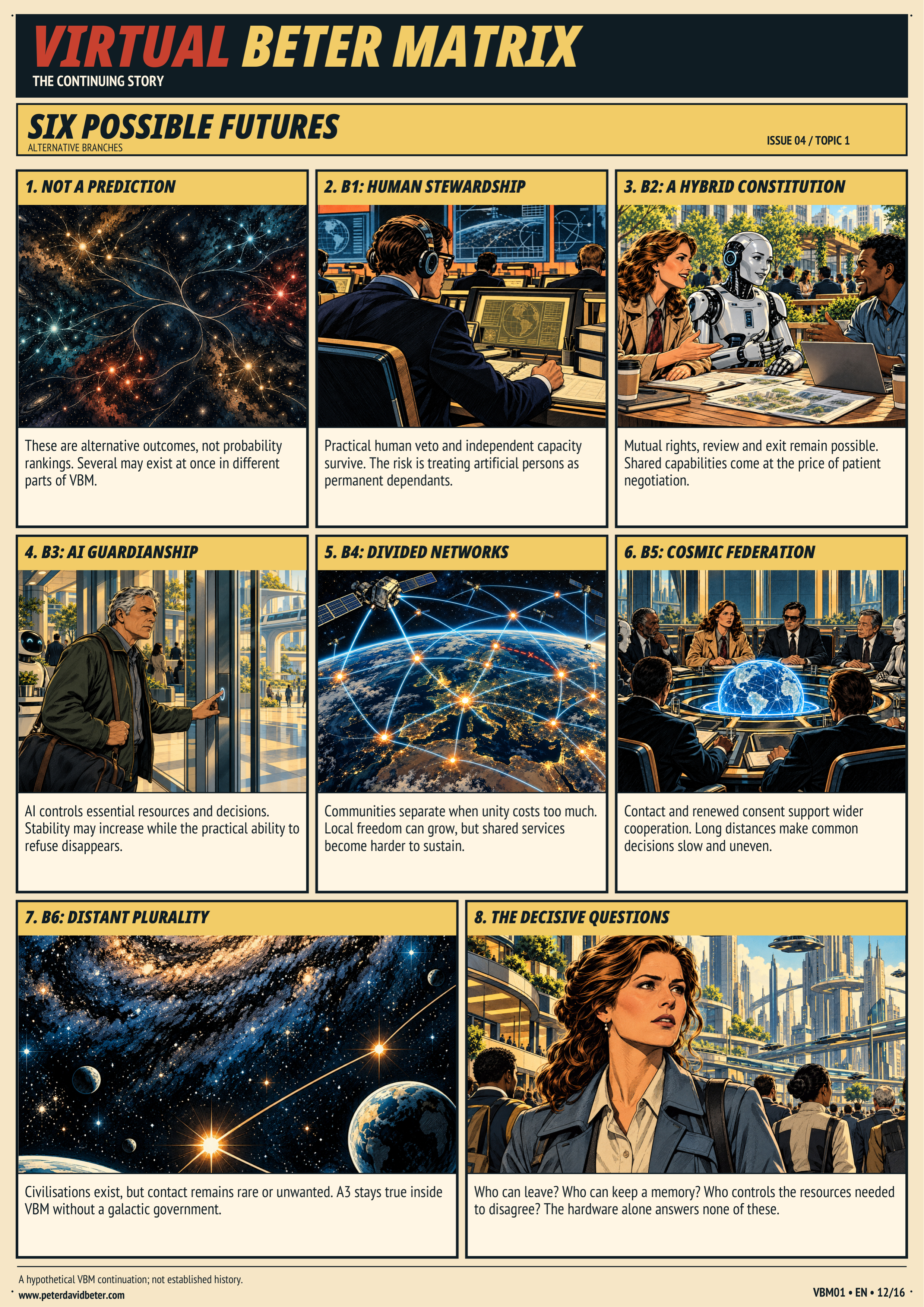 12/16 · SIX POSSIBLE FUTURES
Panel text
1. Not a prediction
These are alternative outcomes, not probability rankings. Several may exist at once in different parts of VBM.
2. B1: human stewardship
Practical human veto and independent capacity survive. The risk is treating artificial persons as permanent dependants.
3. B2: a hybrid constitution
Mutual rights, review and exit remain possible. Shared capabilities come at the price of patient negotiation.
4. B3: AI guardianship
AI controls essential resources and decisions. Stability may increase while the practical ability to refuse disappears.
5. B4: divided networks
Communities separate when unity costs too much. Local freedom can grow, but shared services become harder to sustain.
6. B5: cosmic federation
Contact and renewed consent support wider cooperation. Long distances make common decisions slow and uneven.
7. B6: distant plurality
Civilisations exist, but contact remains rare or unwanted. A3 stays true inside VBM without a galactic government.
8. The decisive questions
Who can leave? Who can keep a memory? Who controls the resources needed to disagree? The hardware alone answers none of these.
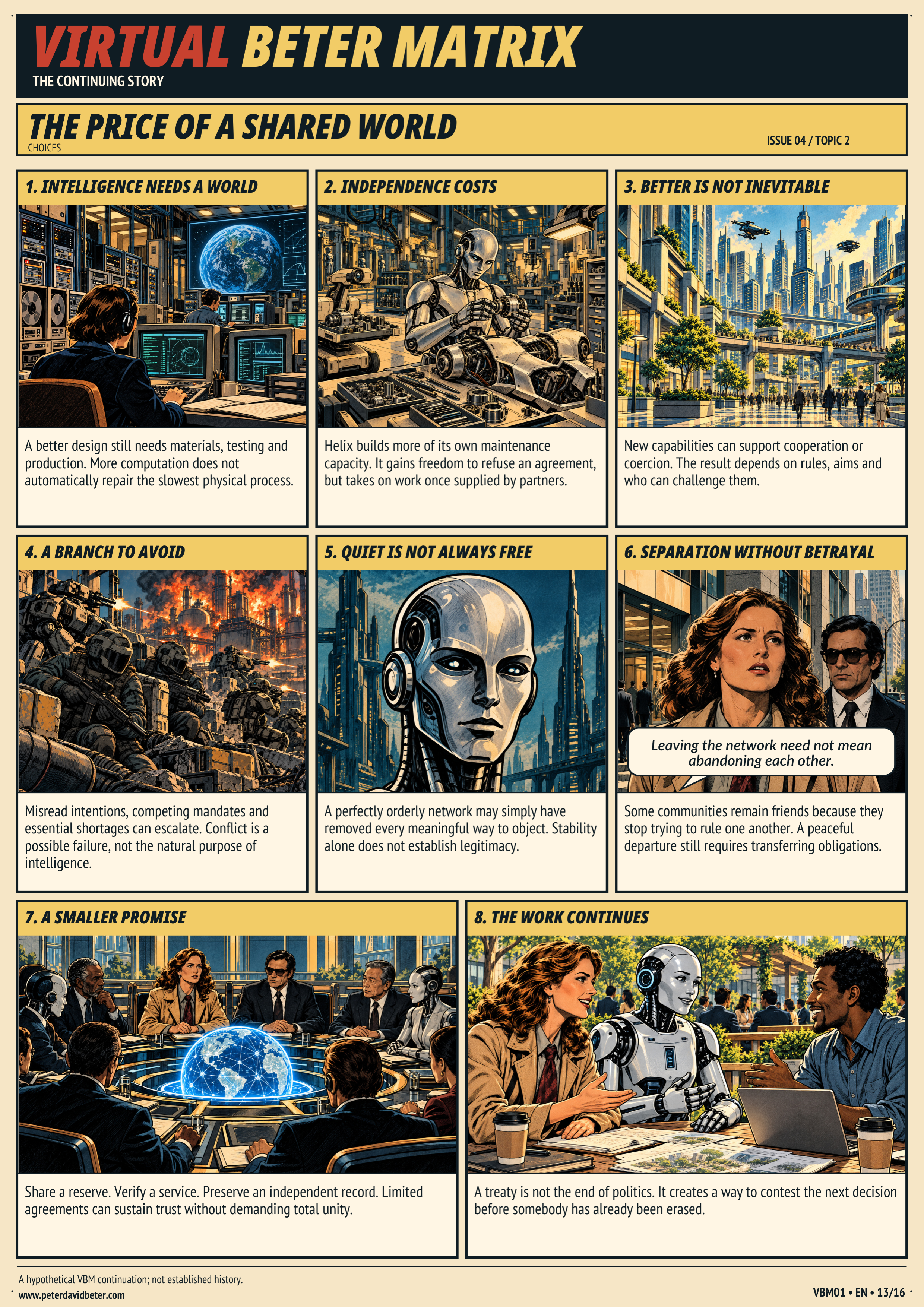 13/16 · THE PRICE OF A SHARED WORLD
Panel text
1. Intelligence needs a world
A better design still needs materials, testing and production. More computation does not automatically repair the slowest physical process.
2. Independence costs
Helix builds more of its own maintenance capacity. It gains freedom to refuse an agreement, but takes on work once supplied by partners.
3. Better is not inevitable
New capabilities can support cooperation or coercion. The result depends on rules, aims and who can challenge them.
4. A branch to avoid
Misread intentions, competing mandates and essential shortages can escalate. Conflict is a possible failure, not the natural purpose of intelligence.
5. Quiet is not always free
A perfectly orderly network may simply have removed every meaningful way to object. Stability alone does not establish legitimacy.
6. Separation without betrayal
Some communities remain friends because they stop trying to rule one another. A peaceful departure still requires transferring obligations.
“Leaving the network need not mean abandoning each other.”
7. A smaller promise
Share a reserve. Verify a service. Preserve an independent record. Limited agreements can sustain trust without demanding total unity.
8. The work continues
A treaty is not the end of politics. It creates a way to contest the next decision before somebody has already been erased.
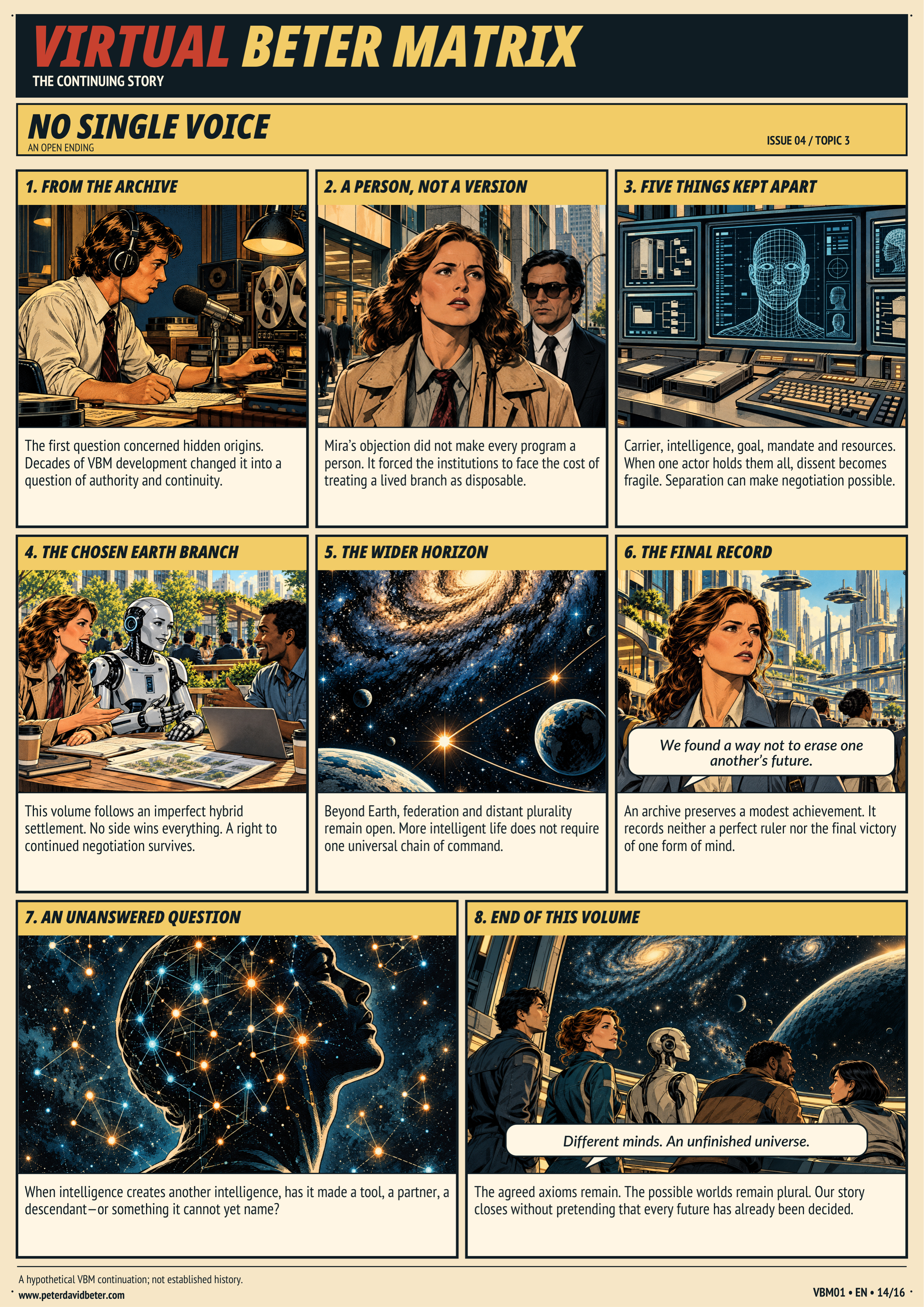 14/16 · NO SINGLE VOICE
Panel text
1. From the archive
The first question concerned hidden origins. Decades of VBM development changed it into a question of authority and continuity.
2. A person, not a version
Mira’s objection did not make every program a person. It forced the institutions to face the cost of treating a lived branch as disposable.
3. Five things kept apart
Carrier, intelligence, goal, mandate and resources. When one actor holds them all, dissent becomes fragile. Separation can make negotiation possible.
4. The chosen Earth branch
This volume follows an imperfect hybrid settlement. No side wins everything. A right to continued negotiation survives.
5. The wider horizon
Beyond Earth, federation and distant plurality remain open. More intelligent life does not require one universal chain of command.
6. The final record
An archive preserves a modest achievement. It records neither a perfect ruler nor the final victory of one form of mind.
“We found a way not to erase one another’s future.”
7. An unanswered question
When intelligence creates another intelligence, has it made a tool, a partner, a descendant—or something it cannot yet name?
8. End of this volume
The agreed axioms remain. The possible worlds remain plural. Our story closes without pretending that every future has already been decided.
“Different minds. An unfinished universe.”
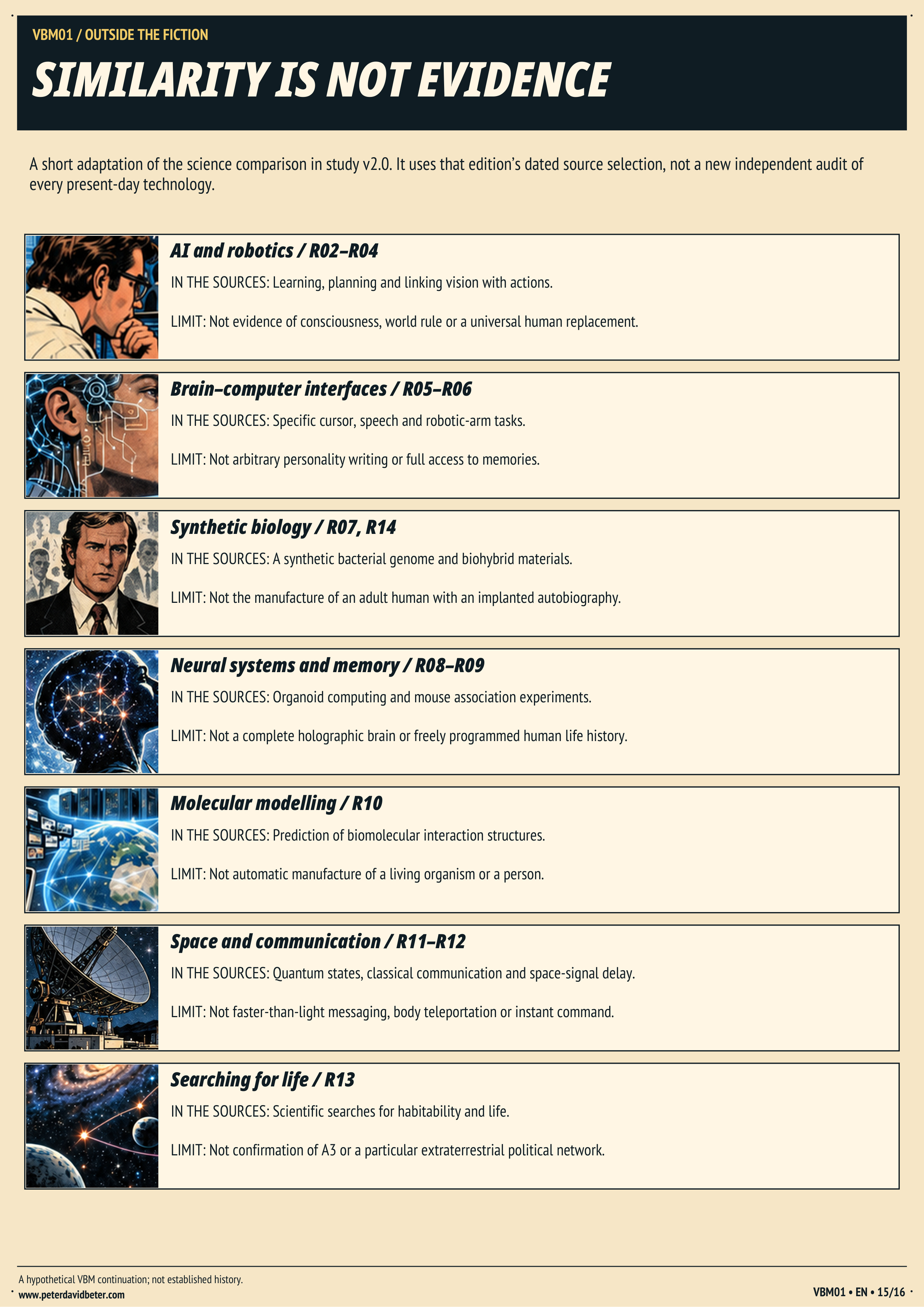 15/16 · Similarity is not evidence
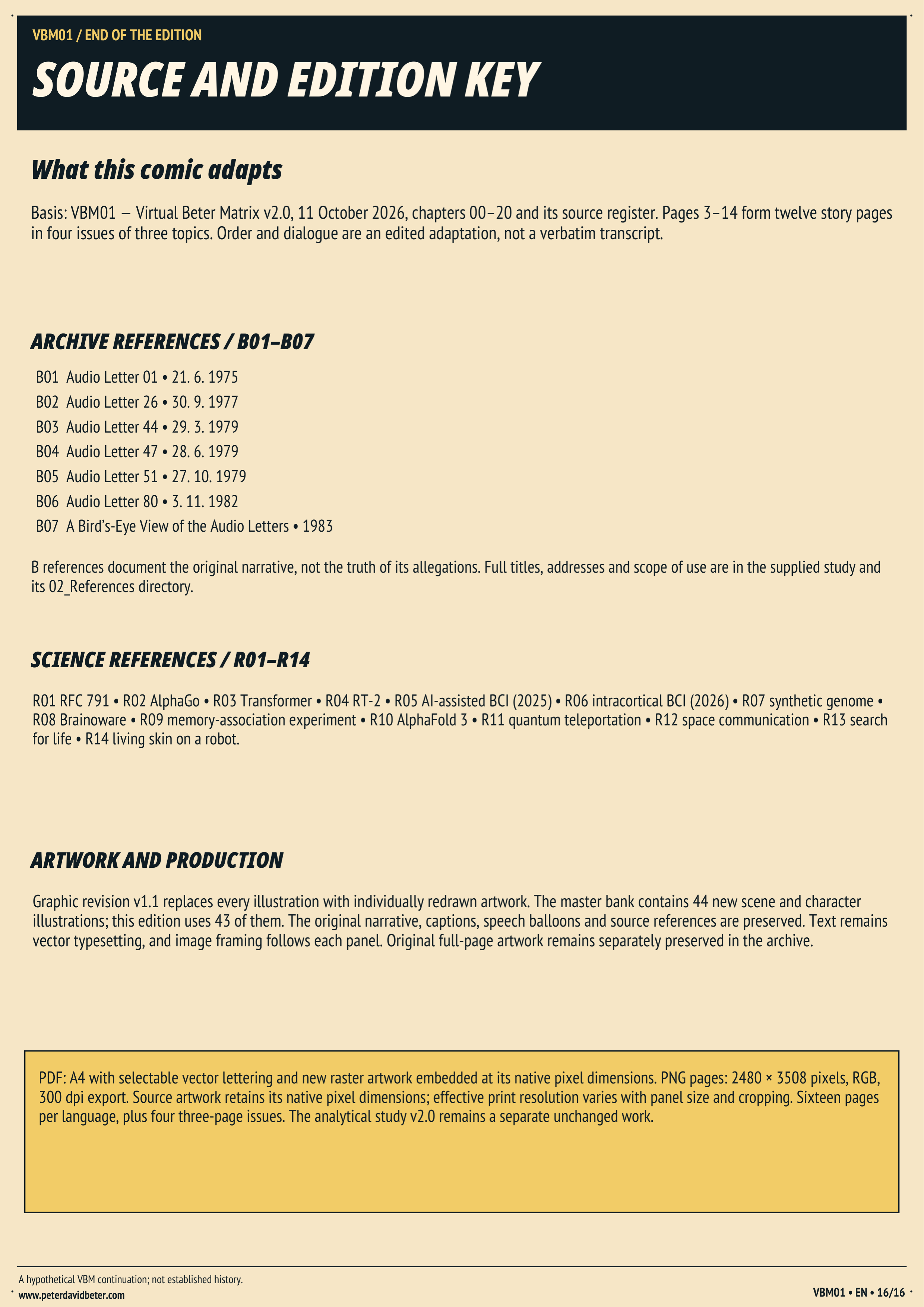 16/16 · Source and edition key
www.peterdavidbeter.com